
Can Ergothioneine Really Brighten Skin and Reduce Hyperpigmentation?
| What Exactly Is Ergothioneine? Ergothioneine(EGT), chemically known as thiol histidine trimethyl inner salt, is a naturally occurring compound. It is mainly derived from mushrooms such as matsutake and hericium eriNACeus. The human body cannot synthesize it on its own and can only obtain it through external intake. Its core advantage lies in superior stability: it does not oxidize in physiological pH or alkaline solutions, and has extremely low irritation—it ranks at Risk Level 1 (the lowest level) among cosmetic raw materials, making it safe for use even by pregnant women. |  |
Sources of Ergothioneine: The Balance Between Natural Extraction and Synthetic Technology
- Natural Extraction: Derived from Nature, but Limited in Yield
In the early days, ergothioneine was mainly extracted from natural mushrooms. For example, only 0.02–0.05 grams of ergothioneine can be extracted from 1,000 grams of fresh matsutake. Additionally, the extraction process requires multiple purification steps, leading to extremely high costs. Furthermore, natural mushrooms are affected by growing conditions, climate, and other factors, resulting in unstable yields that cannot meet the demands of large-scale cosmetic production. However, naturally extracted ergothioneine has a slight advantage in biocompatibility, making it more acceptable to some consumers who pursue "all-natural" products.
- Biosynthesis: Driven by Technology, Becoming the Mainstream
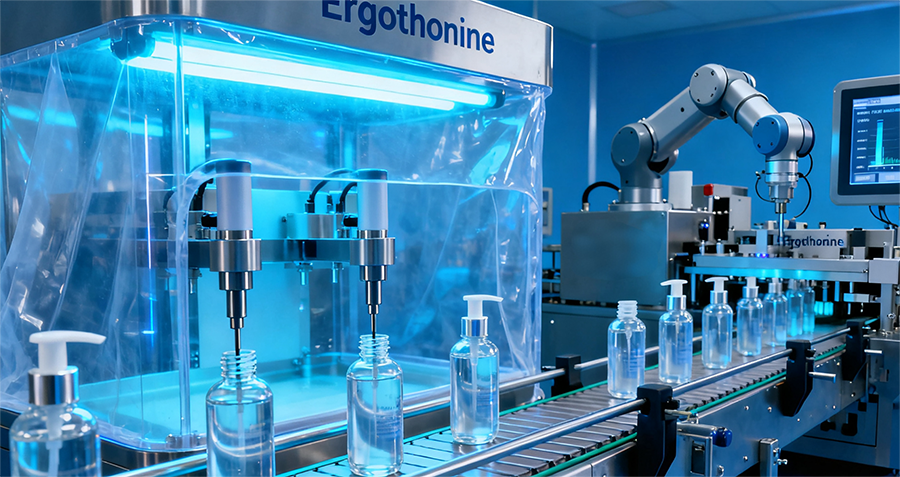
With the development of synthetic biology, microbial fermentation has become the primary method for producing ergothioneine. The current mainstream technology involves genetically engineering microorganisms such as E. coli and yeast to enable them to efficiently synthesize ergothioneine.
Scientific Evidence: How Does Ergothioneine Brighten Skin and Fade Spots?
Its mechanism of action can be explained from three aspects:
- Inhibiting Melanin Synthesis at the Source
The key to fading dark spots is controlling melanin production, and tyrosinase is the "gatekeeper" of melanin synthesis. Experimental data shows that ergothioneine at a concentration of 0.1% inhibits tyrosinase activity by up to 87.62%—a value significantly higher than that of traditional whitening ingredients such as arbutin.
Furthermore, it acts as a "natural sunscreen barrier": it absorbs UVB and UVA , with an absorption peak concentrated in the 290–320 nm band. This reduces UV stimulation of melanocytes and prevents hyperpigmentation at the source. A study published in the American Journal of Biomedical Science & Research found that after 4 weeks of daily intake of 25 mg of ergothioneine, subjects experienced an 18.44% reduction in UV-induced spots and a 16.57% reduction in brown spots.
- Scavenging Free Radicals to Block Pigment Deposition
Oxidative stress is a major cause of dull skin and hyperpigmentation, and ergothioneine is known as a "mitochondria-specific antioxidant." It enters cellular mitochondria via the OCTN-1 transporter and directly neutralizes harmful substances such as hydroxyl radicals and peroxynitrite. In terms of scavenging DPPH free radicals, its efficiency is 14 times that of glutathione and 30 times that of coenzyme Q10.
At the same time, it activates the Nrf2 signaling pathway, increasing the activity of superoxide dismutase and glutathione peroxidase in the skin, thereby enhancing the skin’s natural antioxidant defense capabilities. This "dual antioxidant" effect effectively blocks pigment deposition caused by oxidative damage.
- Reducing Inflammatory Hyperpigmentation and Repairing Skin
Inflammation often triggers post-inflammatory hyperpigmentation. Studies have shown that ergothioneine at a concentration of 10 μmol/L reduces the secretion of the pro-inflammatory cytokine IL-6 by 50%, alleviating skin redness and inflammation, and thus lowering the risk of inflammatory hyperpigmentation.
Additionally, it inhibits the activity of matrix metalloproteinase-1 by 37%, preventing UV-induced collagen degradation and promoting the synthesis of type I collagen. This not only makes the skin fuller and more elastic but also enhances skin brightness from within. In 2024, a randomized, double-blind, placebo-controlled study conducted by Professor Junya Kawai’s team at Kanazawa University (Japan) showed that daily intake of 25 mg of ergothioneine for 12 weeks significantly improved subjects’ skin texture and brightness.
Usage Notes: Avoid Misconceptions to Maximize Efficacy
- Concentration Adaptation: Higher Is Not Always Better
The optimal concentration of ergothioneine varies across different application scenarios. In topical skincare products, the effective concentration for facial serums is typically 0.1%–1%: concentrations below 0.1% yield insignificant whitening and spot-fading effects, while concentrations above 1% are difficult for the skin to absorb and may increase greasiness (especially for oily skin). For eye care products, due to the thinner skin around the eyes, concentrations are usually controlled at 0.5%–5%, and must be paired with moisturizing ingredients such as hyaluronic acid to prevent dryness. For oral products, the clinically recommended daily dosage is 25–60 mg; excessive intake has no known side effects but may increase metabolic burden.
- Compatibility Taboos: Avoid Combining with These Ingredients
While ergothioneine has strong compatibility, combining it with certain ingredients can reduce its efficacy. For example, it should not be used simultaneously with high-concentration acids (such as over 20% glycolic acid or over 10% salicylic acid)—acids damage the skin barrier, reducing the activity of the OCTN-1 transporter (critical for ergothioneine absorption). Additionally, when mixed with vitamin C derivatives (such as magnesium ascorbyl phosphate), pH control is essential (the optimal range is 5.5–7.0); otherwise, slight oxidation of ergothioneine may occur, reducing its antioxidant effects.
- Timing of Use: Daytime Protection + Nighttime Repair for Better Results
For maximum efficacy, we recommend "topical use during the day + oral intake at night" or "daytime sunscreen pairing + nighttime repair." During the day, sunscreens containing ergothioneine enhance UV protection. At night, oral ergothioneine capsules exert antioxidant effects during the skin’s active metabolic phase. Pairing this with an ergothioneine-containing repair cream achieves a "synergistic internal-external effect."
Applications of Ergothioneine in Cosmetics
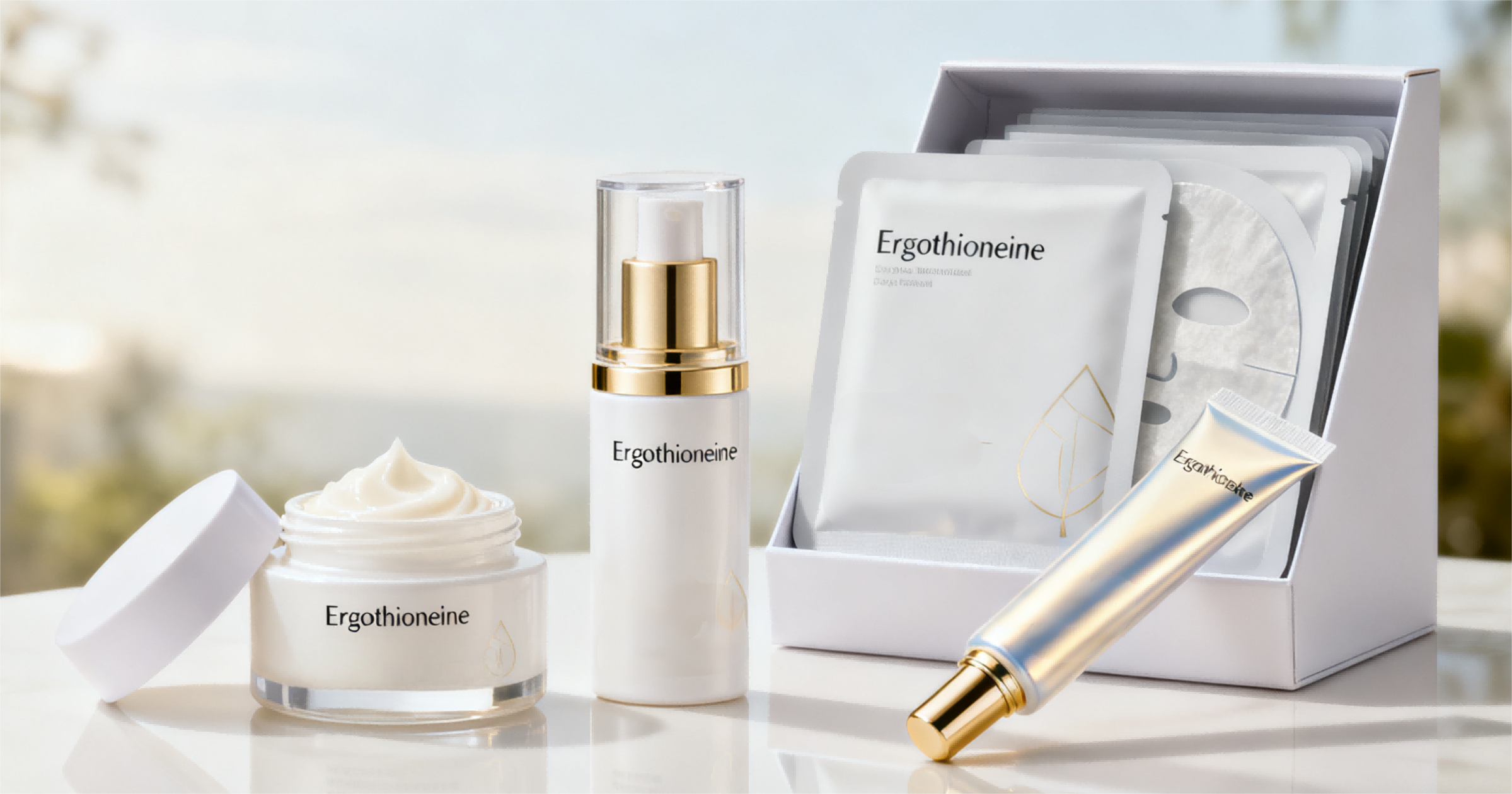
- Topical Skincare Products
Numerous skincare brands incorporate ergothioneine into serums, creams, and sunscreens. For example, some brightening serums use 0.1%–1% ergothioneine as the core ingredient, paired with niacinamide and tranexamic acid to enhance whitening and spot-fading effects. In sunscreens, it not only absorbs UV rays but also repairs UV-induced skin damage, achieving "dual protection + repair" benefits.
- Oral Beauty Products
Oral ergothioneine products have become a new market trend. Data from Q2 2025 shows that ergothioneine-related products account for 44% of the Tmall oral beauty market. The Dr.Ergo® Ergothioneine Capsules launched by Shanghai Ergothioneine Biotechnology Group have been clinically validated: daily intake of 30 mg for 8 weeks significantly improves skin aging indicators with no adverse reactions. The "Aurora Anti-Aging Skin Beauty Pills" by Norwegian brand NYO3 use phospholipid delivery technology, containing 60 mg of ergothioneine per capsule—users experience an 18% increase in skin elasticity after 30 days of use.
- Emerging Application Scenarios
With technological advancements, ergothioneine’s application scenarios continue to expand: in eye care products, concentrations can reach up to 5%, specifically targeting dark circles and eye bags caused by oxidation and inflammation. In scalp care products, it reduces scalp inflammation and improves hair follicle health, thereby reducing hair loss caused by scalp issues. Even in children’s skincare products, some brands add low-concentration ergothioneine (0.05%) to alleviate skin inflammation from eczema and diaper rash.
Conclusion
The answer to "Can ergothioneine brighten skin and reduce hyperpigmentation?" is undoubtedly yes. Its multiple mechanisms—from inhibiting tyrosinase activity and scavenging free radicals to reducing inflammation and repairing skin—are supported by sufficient scientific research. Technological advancements from natural extraction to biosynthesis have made it more cost-controllable and widely applicable, while expanded scenarios from topical skincare to oral beauty meet diverse consumer needs.
With ongoing breakthroughs in synthetic biology and increased consumer awareness, ergothioneine is expected to become a "mainstream ingredient" in whitening skincare within the next 3–5 years.
- Name: Yuki
- E-mail: sales02@nahanutri.com
- WhatsApp:+8618066950297